

How Solar Systems Work
to Power Your Home
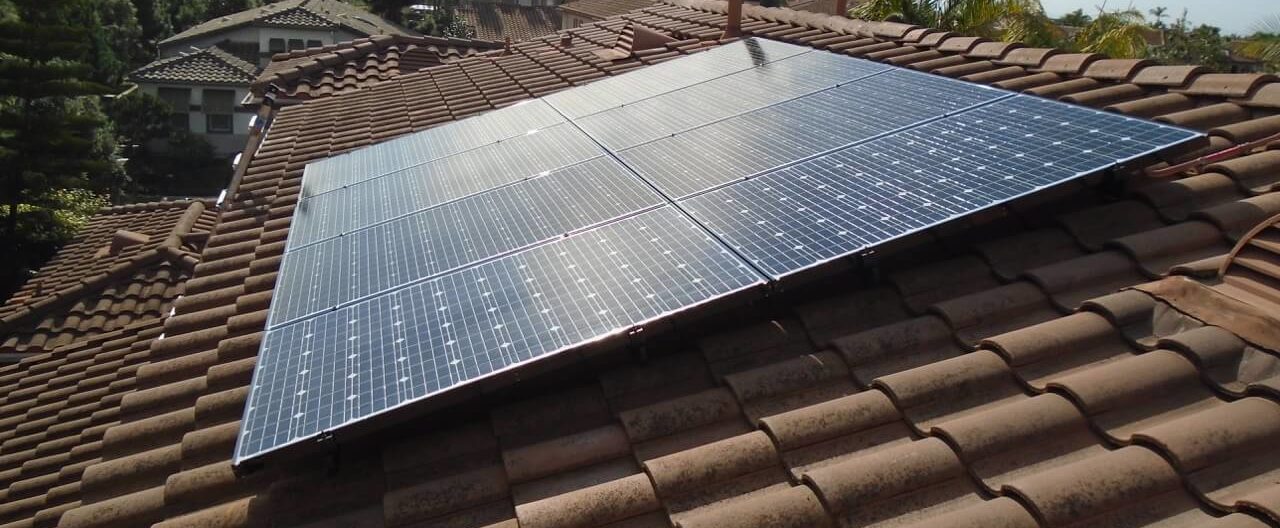
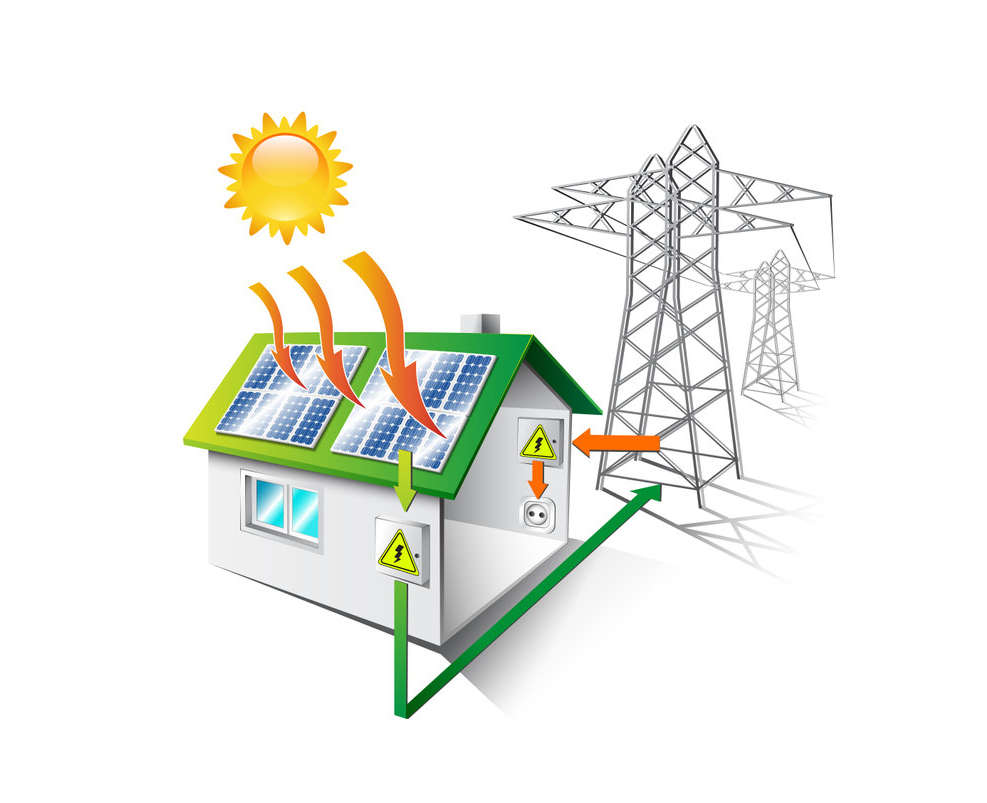
Solar panels are installed in a sunny location, usually on the roof of your home. As the day begins, light hits the solar panels, and they start producing electric power. This power flows through your electric service panel to power your home.
As the morning progresses, your solar panels will often produce more power in real time than your household is using. This “excess” energy is generally stored in a battery, to be consumed at nighttime. Once your household needs are met and your battery is full, any additional solar power will flow back to the utility grid. You will receive a small credit from SDG&E for each kWh you send back.
During times in which your solar and battery system are not producing enough energy to completely power your home (e.g. when it’s raining), you can still get electricity from SDG&E, just as you always have. Whether your electric energy is coming from your solar and battery system or from SDG&E, your home will operate the same. San Diego County Solar’s expert consultants will work with you on a solar and battery system designed to minimize your reliance on SDG&E.
Benefits of Solar Power
“I’d put my money on the sun and solar energy. What a source of power!”
-Thomas Edison
SAVINGS
Pay less each month with solar than you would otherwise pay to SDG&E, and protect yourself from future electric rate increases.
SUSTAINABILITY
Help society transition to a more sustainable model by taking advantage of a renewable resource.
PROPERTY VALUE
Increase the value of your home, benefiting a future sale or equity loan.
BACKUP POWER
Use solar energy stored in your battery to provide power to your home, in case of a utility blackout.
Once you have the equipment,
the fuel is free!
Once you have a solar and battery system at your home, you can operate largely independently from SDG&E’s grid. Our customers tell us it feels terrific to gain this freedom from ever-increasing utility rates, to take direct control over their power generation, and to be able to keep the lights on even during a utility blackout!
The sun rises most every day in San Diego. With your own solar power plant, you can generate clean, renewable energy, right where it’s needed. This helps improve our national security, as we become less dependent on energy resources from other nations. Installing solar is a step toward a more peaceful planet for future generations.
Beyond saving money on utility bills, clean energy generated from solar panels will help your family and your community breathe easier. Help break our dependence on fossil fuels, and leave a legacy you can be proud of.
If you haven’t yet installed solar panels on your home, we’re happy to help you determine if it makes sense for you.

Frequently Asked
Questions
Solar panels and batteries represent a big shift from how we’re accustomed to harnessing energy, but the process does not have to be confusing. Read on to learn just how easy and beneficial installing solar can be for your home!
How does billing change with SDG&E?
The energy from solar first powers your home, in real time. “Excess” solar power produced is generally stored in batteries for nighttime use. Once your household needs are met and your battery is full, additional solar power will flow back to the utility grid. You will receive a small credit from SDG&E for each kWh you send back.
You will continue to pay a monthly bill to SDG&E, but it will be much smaller than before. Depending on the size of the solar and battery system relative to your electricity usage that month, you may just have to pay SDG&E the minimum monthly meter fee.
Sizing a solar and battery system is not as straight-forward as it may seem. The first step is to look at your past electric usage patterns, month-by-month, as well as hour-by-hour. Then it’s important to consider how your electric usage patterns may change in the near future.
Many of our customers plan to use more air conditioning when they get solar, to add a pool or a hot tub, or to get an electric vehicle (EV). Others plan to upgrade their kitchen or their hot water heating from gas to electric. Still others want to plan for their upcoming retirement, for their adult children moving out, for their elderly parents moving in, or even for an Accessory Dwelling Unit (ADU).
All of these factors, and many more, must be properly accounted for when designing the best system for your home. Our expert consultants will guide you through the system design process, based on your actual site conditions (e.g. roof orientation and shading, main electric panel condition, etc.), to arrive at a system that is configured for your specific family’s long-term needs.
Solar panels have no moving parts, can withstand extreme weather, and require virtually no maintenance throughout their entire lifespan. According to a UCSD study, it’s generally not necessary to even clean your solar panels.
That being said, at some point your solar inverter and battery will reach their end-of-life. The good news is that every system we install comes with online monitoring, so that any problems can be easily identified and resolved. Through the monitoring app, you’re able to see exactly how much electricity your solar is producing, as well as how much electricity your household is using.
A common misconception is that San Diego coastal homes do not benefit from solar power because the marine layer will compromise performance. We have installed thousands of solar panels near the ocean with excellent results – they actually perform best in bright but cool conditions. To estimate production, we account for the historical weather data in your specific area, whether that be coastal Encinitas or La Jolla, Escondido or La Mesa, Clairemont or Carlsbad. You will produce less solar when it’s cloudy, but each kWh you produce will be offsetting some of the most expensive electricity costs in the country.
Storing Your
Solar Energy
How Solar Energy Storage Works
For most homeowners, storing energy generated from your solar electric system in batteries can make a lot of sense. While battery storage has been used for decades in off-grid solar applications, it now usually makes sense to add energy storage to grid-tied solar systems too. Storage systems benefit homeowners by giving them more control over how and when they obtain the energy they need. Batteries can also be set up to provide partial or whole-home backup power in times of SDG&E power outages.
Battery technology has come a long way in recent years, and you may be surprised how affordable a combined solar and battery system can be.